Licenced drivers Note
GPS on a mobile phones do not work when out of Mobile Phone range
Forklift licenses
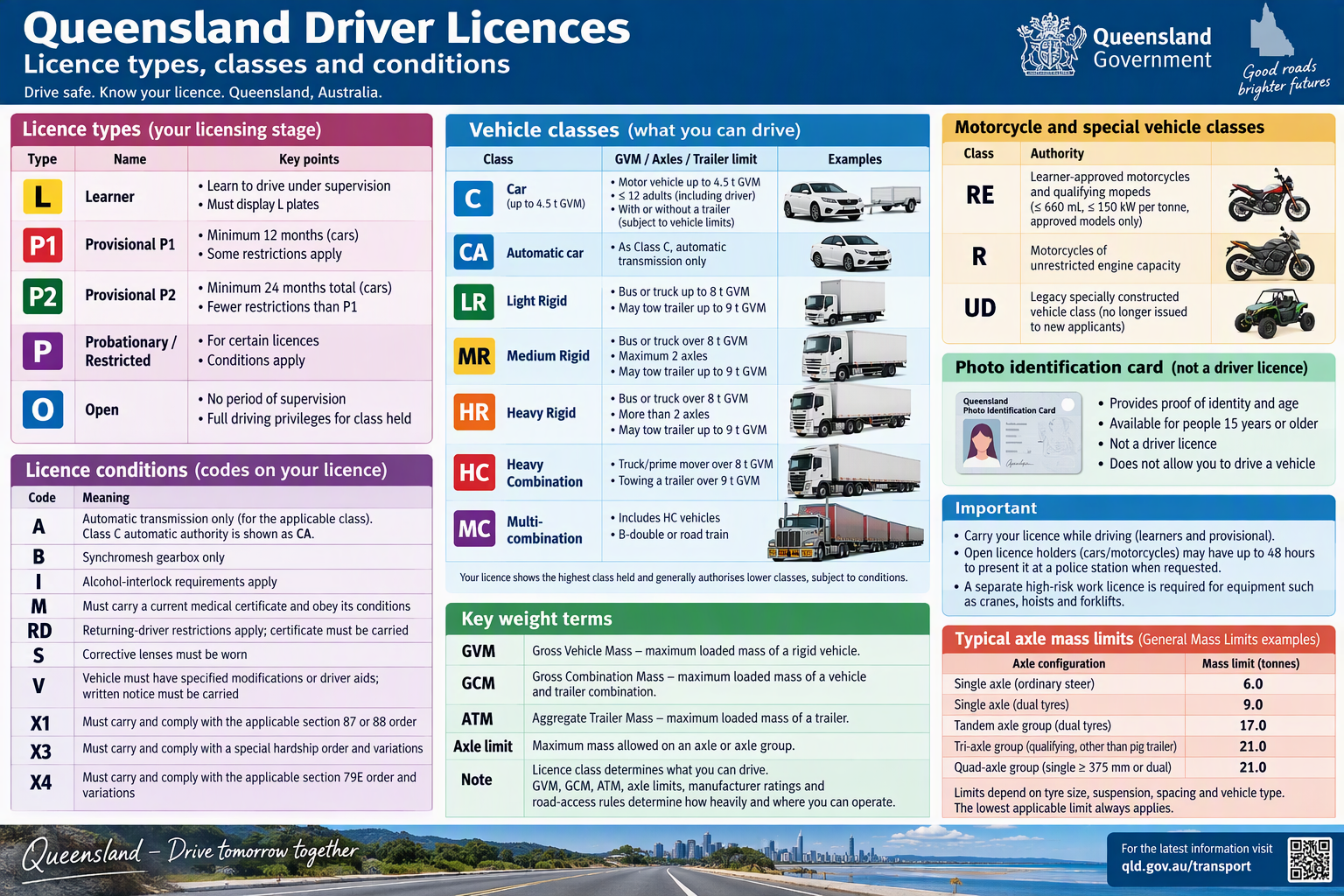
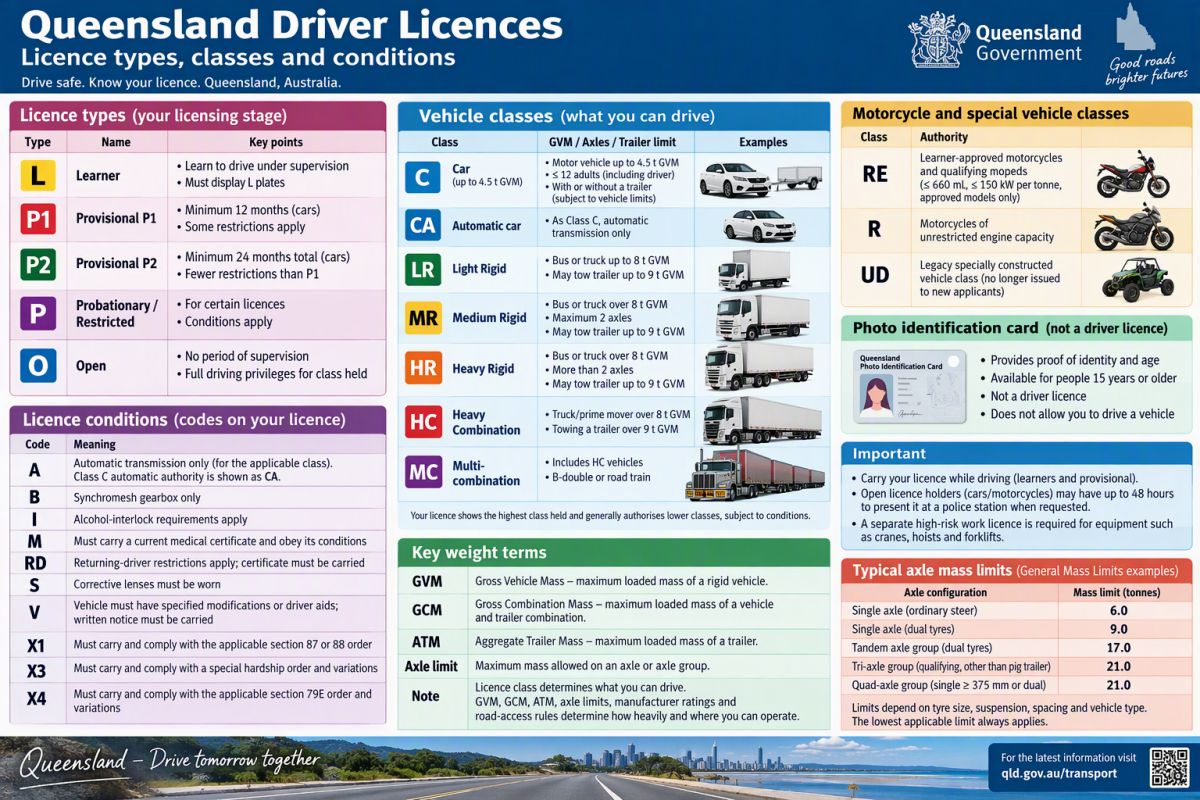
Below is a practical Queensland reference covering photo identification, licence types, vehicle classes from C through MC, licence conditions, and the relationship between licence class, GVM, trailers and axle limits.
1. Photo identification card
A Queensland Photo Identification Card is not a driver licence. It provides official proof of age and identity for people aged 15 years or older, including people who do not hold a driver licence or passport. [Licensing…ain Roads)]
It does not authorise the holder to drive a motor vehicle.
2. Queensland licence types
Licence type describes the driver’s licensing stage. Licence class describes the vehicles they may drive.
| Code | Licence type |
|---|---|
| L | Learner |
| P1 | Provisional P1 |
| P2 | Provisional P2 |
| P | Probationary or restricted |
| O | Open |
Learner and provisional drivers must carry their licence while driving. An open-licence holder driving a car or riding a motorcycle may be allowed up to 48 hours to present it at a police station when requested. [qld.gov.au]
3. Vehicle licence classes
Class C and CA
| Class | Vehicles authorised |
|---|---|
| C, Car | Motor vehicle up to 4.5 tonnes GVM, built or fitted to carry no more than 12 adults including the driver. It can be driven with or without a trailer, subject to the vehicle’s towing and mass limits. Also covers certain mopeds and specially constructed vehicles. |
| CA, Automatic car | A Class C vehicle with an automatic transmission only. |
A moped driven under Class C must have a maximum engine capacity of 50 mL, or an electric motor, and a manufacturer’s maximum rated speed of 50 km/h. A passenger cannot be carried when the moped is being ridden under a car licence. [qld.gov.au]
Heavy-vehicle classes
| Class | GVM, axles and trailer threshold | Typical examples |
|---|---|---|
| LR, Light Rigid | Bus or truck up to 8 t GVM. May tow a trailer up to 9 t GVM. | Small rigid truck, light bus, qualifying motorhome |
| MR, Medium Rigid | Bus or truck over 8 t GVM, with a maximum of 2 axles. May tow a trailer up to 9 t GVM. | Two-axle rigid truck or bus |
| HR, Heavy Rigid | Bus or truck over 8 t GVM, with more than 2 axles. May tow a trailer up to 9 t GVM. Also covers an articulated bus. | Three or four-axle rigid truck, large bus |
| HC, Heavy Combination | Truck, prime mover or qualifying mobile crane over 8 t GVM, towing a trailer over 9 t GVM. | Prime mover and semitrailer, rigid truck and heavy trailer |
| MC, Multi-combination | Includes HC vehicles, plus a B-double or road train. | B-double, Type 1 or Type 2 road train, subject to vehicle and road-access approvals |
These are the official Queensland licence-class definitions. The licence displays the highest class held, and generally authorises vehicles in the lower classes, subject to any licence conditions. [qld.gov.au]
The key progression
C: up to 4.5 t GVM
LR: up to 8 t GVM
MR: over 8 t, maximum 2 axles
HR: over 8 t, more than 2 axles
HC: heavy vehicle plus trailer over 9 t GVM
MC: B-double, road train and other multi-combinations
4. Motorcycle and special vehicle classes
| Class | Authority |
|---|---|
| RE | Learner-approved motorcycles and qualifying mopeds |
| R | Motorcycles of unrestricted engine capacity |
| UD | Legacy specially constructed vehicle class |
For RE, a learner-approved internal-combustion motorcycle has a maximum engine capacity of 660 mL, a maximum power-to-weight ratio of 150 kW per tonne, and must be on Queensland’s approved list. The UD class is no longer issued to new applicants. [qld.gov.au]
A separate high-risk work licence may still be required to perform work using equipment such as a crane, hoist or forklift. A driver licence by itself does not authorise high-risk work. [qld.gov.au]
5. Common licence conditions
Conditions apply whenever the affected vehicle class is being driven.
| Code | Meaning |
|---|---|
| A | Automatic transmission only for the applicable class. Class C automatic authority is shown as CA. |
| B | Synchromesh gearbox only |
| I | Alcohol-interlock requirements apply |
| M | Driver must carry a current medical certificate and obey its conditions |
| RD | Returning-driver restrictions apply; certificate must be carried |
| S | Corrective lenses must be worn |
| V | Vehicle must have specified modifications or driver aids; written notice must be carried |
| X1 | Driver must carry and comply with the applicable section 87 or 88 order |
| X3 | Driver must carry and comply with a special hardship order and variations |
| X4 | Driver must carry and comply with the applicable section 79E order and variations |
The A condition can apply differently across classes. For example, a licence displaying Class C with a separate A condition may still authorise a manual car because the A condition can apply only to the heavy-vehicle class. A car restricted to automatic transmission is displayed as CA. [qld.gov.au]
6. Licence GVM versus legal operating mass
This distinction is important:
- Licence-class GVM and axle numbers determine the minimum driver-licence class.
- GVM is the maximum loaded mass assigned to a rigid vehicle.
- GCM is the maximum loaded mass assigned to a vehicle and trailer combination.
- ATM is the maximum loaded mass assigned to a trailer.
- Axle and axle-group limits control how that mass may be distributed.
- Road-access notices, permits, posted bridge limits and manufacturer ratings can impose lower limits.
The legal mass is not simply the total of every axle rating. Under the current National Heavy Vehicle Regulator rules, the permitted mass is constrained by the applicable overall combination limit, axle or axle-group limits, axle-spacing limits, manufacturer ratings and any road-access restriction, with the lowest applicable limit governing operation. [nhvr.gov.au]
7. Current General Mass Limits for axles
The following are important examples under the General Mass Limits applying after the Heavy Vehicle National Law changes that commenced on 1 August 2026. [nhvr.gov.au]
Single axles
| Axle configuration | General mass limit |
|---|---|
| Ordinary motor-vehicle steer axle | 6.0 t |
| Complying steer axle vehicle | 6.5 t |
| Single axle, single tyres under 375 mm | 6.0 t |
| Single axle, single tyres 375 to under 450 mm | 6.7 t |
| Single axle, single tyres at least 450 mm | 7.0 t |
| Single axle with dual tyres, ordinary vehicle | 9.0 t |
| Single axle with dual tyres, pig trailer | 8.5 t |
Tandem axle groups
| Configuration | General mass limit |
|---|---|
| Single tyres under 375 mm | 11.5 t |
| Single tyres 375 to under 450 mm | 13.8 t |
| Single tyres at least 450 mm | 14.5 t |
| Mixed single and dual tyres, ordinary motor vehicle | 13.5 t |
| Dual tyres, pig trailer | 15.0 t |
| Dual tyres, other vehicle | 17.0 t |
Twinsteer and tri-axle groups
| Configuration | General mass limit |
|---|---|
| Twinsteer without load-sharing suspension | 10.0 t |
| Twinsteer with load-sharing suspension | 11.0 t |
| Qualifying Euro VI twinsteer | 11.5 t |
| Tri-axle with specified narrow single-tyre configuration | 15.5 t |
| Qualifying tri-axle group on a pig trailer | 18.0 t |
| Qualifying tri-axle group on a vehicle other than a pig trailer | 21.0 t |
Quad-axle groups
| Configuration | General mass limit |
|---|---|
| Narrow single tyres under 375 mm | 15.5 t |
| Single tyres at least 375 mm or dual tyres | 21.0 t |
These values depend on tyre width, tyre arrangement, vehicle type, suspension and other qualifications. Axle spacing can reduce the permitted vehicle or combination mass. For example, where two axles that are not in the same axle group are less than 2.5 metres apart, the heavy vehicle’s mass must not exceed 15 tonnes. [nhvr.gov.au]
8. Overall combination limits
The current GML table includes the following examples:
- A complying-steer-axle vehicle that is neither a B-double nor a road train: 44.0 t.
- A qualifying Euro VI complying-steer-axle vehicle that is neither a B-double nor a road train: 44.5 t.
- A standard twinsteer prime mover towing a tri-axle semitrailer: 47.5 t.
- A qualifying Euro VI twinsteer prime mover towing a tri-axle semitrailer: 48.0 t.
- A vehicle not otherwise specified, and which is neither a B-double nor a road train: 43.5 t. [nhvr.gov.au]
These are mass-law limits, not licence-class definitions. Holding HC or MC does not automatically authorise operation at every published mass or on every road.
Practical rule
Licence class tells you whether the driver can drive the configuration. GVM, GCM, ATM, axle loading, axle spacing, manufacturer ratings and road-access rules tell you how heavily and where that configuration can operate.
Official references:
- Queensland licence types, classes and conditions
- Queensland Driver Licence Classes, Codes and Conditions Information Sheet
- NHVR General Mass Limits
If you’re asking about road guidance/navigation options, there are generally three main choices:
- Mobile Phone GPS Apps
- Google Maps
- Waze
- Apple Maps (iPhone)
- HERE WeGo
- Free or low cost
- Live traffic updates
- Automatic rerouting
- Voice guidance
- Uses battery power
- May require mobile data for full functionality
- Can overheat in direct sunlight
- Dedicated GPS Units
- Garmin
- TomTom
- Designed specifically for navigation
- Reliable GPS reception
- No dependence on phone battery
- Some models support truck and caravan routing
- Additional purchase cost
- Map updates may require subscriptions on some models
- Vehicle Integrated Navigation
- Built into many modern cars and trucks.
- Large screen
- Integrated with vehicle systems
- No need for a phone mount
- Map updates can be expensive
- Traffic information varies by manufacturer
For truck drivers in Queensland and Australia, apps like Google Maps and Waze are useful for general navigation, but truck-specific navigation from Garmin Dezl or dedicated heavy-vehicle routing systems is often better because they can consider vehicle size, weight, and road restrictions.
If you’re looking for the best GPS solution for cars, trucks, caravans, or road trains, I can recommend specific devices and apps for your use case.